
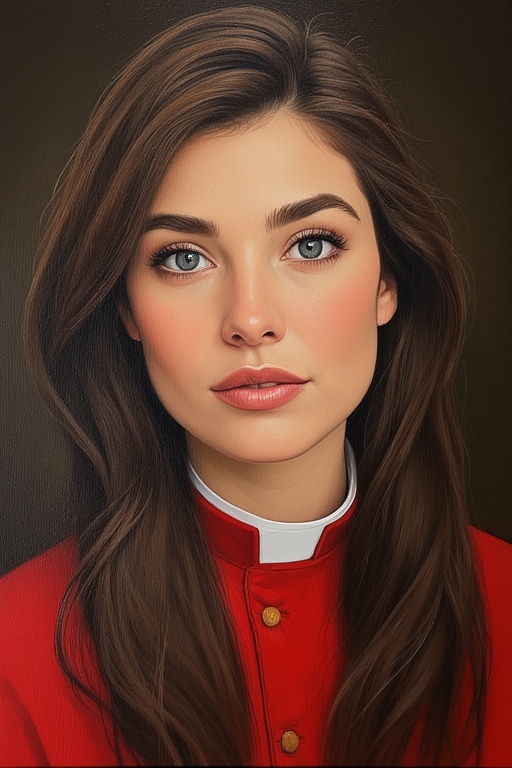
Meet Damië Coralin Callens, a Vin-Nórëan priestess in Par-Isen
by Jessica Haniuel, submitted on the 23rd of Celestiath in year 527
Greetings, fellow Isenites! This month’s edition of Court Chatter features a real rarity around the basílica: a priestess-knight from Saint Hilden’s! Stop blinking, you read that right! She’s a real live mystic who’s come out of the cloister to serve the God of Paladins in the field of battle as well as politics. Read on to learn more about Damië Coralin Callens, orphaned ward of the Duke of Núrinen and the late Queen Ariellë of Vin-Nórë, heir to the barony of Andas, now serving in the Imprimæ’s court.
J: Good day, Damië Coralin, and thank you for giving me the opportunity to interview you.
C: Good day to you, Mistress Haniuel. It is good to be here.
J: Let’s start with the basics. You are Vin-Nórëan, of course, born in the barony of Andas, and your parents were the barons. They died when you were quite young, I believe?

C: Yes, I was just three. There was a catastrophic flood that year. My parents died while attempting to rescue those who were trapped by the rising waters.
J: And then you were taken in by Duke Robaire Mirac and his wife, the late Queen Ariellë Chandrikken.
C: Yes indeed. A very privileged upbringing with two of the best, most wonderful brothers for which any girl might wish.
J: But that is unusual, surely. Had you no other family?
C: None of which they were aware. My parents had lost most of their families during the war in Vin-Llammáz. They came to Núrinen with Duke Robaire—then the Count of Briasten—before Arminas, and of course Vin-Llammáz, fell under Confederation control.
J: And you lived with them for how long?
C: Ten years, almost to the day.
J: What was it like to live with the royal family?
C: (chortles) Well they were my family, I knew no other, so have little with which to compare it. They were always honest with me about my parents and what had happened to them, so I was never led to believe that I was their child by birth. But I was never made to feel inferior by them, either. My brothers always treated me as their sister. Athos in particular… he and I were born on the same night, almost in the same hour, and we were as close as twins in most ways. And Castamir was the older brother who got us into a lot of trouble, but he was always there to get us out of it, too. Our parents worked long hours and there were times when they simply were not available to us, but when they were spending time with us none of the court funtionaries were permitted to interrupt short of an emergency. They shielded as much of the war from us as they could—it was a very loving, privileged upbringing. So much so that I did not want to leave, when the time came.

J: To Par-Isen for training, yes? Why did you not remain in Núrinen? It is a duchy and has its own Yl-Sarjaan and a great cathedral, and so can train and ordain its own clerics. And yet, you were sent here in spite of the risks?
C: (nods) It was necessary, or my Lady Mother the Queen would not have allowed it. I had begun to fall into involuntary trances where I saw and spoke with the Lady or the Lord of Paladins. They came on without warning, lasted sometimes for hours. The family’s priestess was also a mystic and so recognized that what was happening to me was in fact the onset of mystical gifts. I needed more close care and training than she could provide alongside her other duties, so with my guardians’ consent she arranged for me to to come to Par-Isen, and to stay at Saint Hilden’s Monastery, where I could be properly trained to manage my gifts.
J: I see. That is a very long journey—eight or nine hundred kilometers, is it not? So you were thirteen years old at the time?
C: Yes. A journey "fraught with peril," as the stories say. It took us about a month to reach the safety of the Great Gate at Baraüd-Héredlin.
J: And you’ve never returned to Núrinen in the years since?
C: (shakes head sadly) No, never. Until recently, it has been much too dangerous. If I could ever have managed it, it would have been in 518, the year of Queen Ariellë’s assassination and my foster-brother Castamir’s ascension to the throne. I could never have arrived in time for the funeral, but I could have at least been there to grieve with them all.

J: But, on a happier note, your foster brother Prince Athos is now Royal Lord Marshal of the Vin-Nórëan military, and is largely responsible for the recent string of military victories. Do the two of you correspond?
C: (smiles again) Yes, yes he is, and yes, we do. As I intimated earlier, he and I were always very close as children. I think the worst part of being sent away was that I had to go without him. We had long dreamed of entering the priesthood together, he and I—but he had duties to Vin-Nórë and to the throne that required him to stay. So in a way, I’m living out that dream for us both.
J: Well then, let’s talk about that. Until a few years ago you were serving as a priestess in Meridar Vale—specifically at border Outpost One. Now, everyone knows that women capable of child-bearing are not permitted in any capacity where there is a risk of being taken captive by Confederation forces. And yet you served there long enough to win not just one White Rose award, but two!
C: I did, at the will of the Lady of Paladins. She told me it was time for me to go to Outpost One, so I began the journey of faith that took me there. I doubt I would ever have had courage enough to go there by choice.
J: Did the Lady give you courage, then?
C: No, but She did help me discover my own.
J: This is extraordinary. Would it be too much to ask you to describe that journey for those of us who haven’t a clue?
C: Well, I can try to tell you how it went for me. It is different for everyone, you understand. The Lady came to me while I was in meditation, and in an altered state of consciousness, to tell me it was time for me to go to Outpost One. She did not say how, of course. On the face of it, the doing seemed extremely unlikely if not impossible.
J: Hold on—as a priestess, how did you know it was the Lady’s voice, and not some imagining of your own?
C: (smiles) There is no mistaking that Voice, but also no way to describe it. It is somewhat like being able to hear the sweet fragrance of flowers in sunshine. I could not replicate it, and I seriously doubt it could in any way be successfully replicated.
J: I see what you mean. Well, at least I think I do. So how did you accomplish this impossible deed?

C: As I recall, it was made simpler by treating it as a series of steps to take. I did what seemed both necessary and honorable to take each step, and only when I had was the next step revealed to me. Every step seemed to take a greater amount of courage than the previous, and they didn’t end when I finally arrived there. The last step revealed the Lady’s reasons for placing me at Outpost One, and taking that step almost required more courage than I had: To ride out of the relative safety of the outpost with a company of knights-paladin to discover what had happened to another company that had been ambushed by Confederation forces. But, I found that each step of the journey put me exactly where I needed to be, when I needed to be there. My induction into the Order of the White Rose is one of the things that came from it.
J: Oh? There was something else?
C: Oh certainly. I have been blessed by enduring friendships with six of the most honorable and courageous knights-paladin I’ve ever known.
J: Wealth beyond reckoning, that. Were they also involved in the second White Rose award? And was it the same sort of process for you?
C: Some of them were involved, yes, but the events that took place required a degree of surrender to God’s will that tasked me to my uttermost limits. I cannot tell you much about it, I am afraid. Many of the details of that second award have been placed under the seal of confidentiality by the (takes a deep breath) Consulate for the Verification of Miracles and the Nominations of the Saints---
J: Or "Saints and Miracles," in short.
C: That's right---as well as by the High Lord Marshal’s directive. What I can say is that it involved discovering and destroying one of the breeding camps in the swamps on the other side of the border with what was once Vin-Llammáz. Then with a great deal of God’s help, leading the traumatized survivors through the swamp, and back to safety.
J: I see. The confidentiality is given out of courtesy and respect to the survivors.
C: Just so.
J: It must have been utterly terrifying.
C: It was, almost every waking moment of it. But as a priestess, it taught me the hard lessons: That there are more important things than being afraid. That being God’s servant will at times put one in harm’s way, especially when other lives are at stake. And that it takes a great deal of faith and determination to get through those lessons with one’s heart and soul intact.
J: And you returned to serve as a priestess in Khir-Isen shortly afterward?
C: (nods) After I recovered, my mentor, Sijainen Dupré, got me transferred to her consulate for training in international politics, or what passes for them in these dark times. I split my time between her offices and those of our Yl-Sarjaan, Matrië Avice Ward so I can also learn what it takes to run a church, hopefully of my own, someday.

J: That brings us not only to the present, but projects hope into the future too—a good place to bring this interview to an end. Damië Coralin, thank you for sharing so much with us today. It has been fascinating, and a pleasure. May I have your blessing before I go?
C: (smiles and sketches the sign of Isenbrand in the air between us) Of course. May God’s blessings be with you and your readers, always.
The Menelon Gazette
If you are interested in more content like this (plus freebies, access to premium content etc.) subscribe to our newsletter for more from the world of Menelon and its creators!