

If you’ve been searching for faith-forward romantasy — the kind where the divine is genuinely present in the story rather than hovering at its edges as atmosphere — this is the post that explains why What God Has Ordained was written that way, and what it means to write gods in fantasy fiction who actually show up.
You know that moment in some fantasy novels where a character says a prayer, and nothing happens? Or something does happen, but its cause is pretty ambiguous? It may be the divine answer, but it could be just coincidence. Or just possibly, it’s the author leaving room for the skeptic reader to make their own call.
I understand that impulse. Faith in fiction is tricky. Push too hard and you’re preaching. Pull back too far and the gods are just window dressing.
In creating the theology of Menelon, Michael and I made a deliberate choice to let the gods act. Not as subtext. Not as metaphor. Rather, as a character with will and intention who intervenes in the plot — with rules, limits, and consequences, just like everything and everyone else in the world.
That choice has, in a lot of ways, framed much of what What God Has Ordained is about.
Fantasy With Religion: The Problem of Background Gods

If you read widely in romantasy and epic fantasy — or fantasy with religion more broadly — you’ll notice that most fictional gods in fantasy religions fall into one of a few familiar shapes.
- There’s the corrupt church — faith as an institution of power and hypocrisy, with the protagonists either dismantling it or surviving it.
- There are the absent gods — religion as history and culture, the deity long-vanished or never confirmed to exist.
- There’s the magical system dressed in priestly robes — power that looks like faith but functions like science.
- And there’s the metaphor — the divine as a way of talking about human hope, grief, or moral courage without making any cosmological claims.
All of these work. I’ve loved books that use every one of them. But none of them are related to the story I wanted to write.
In Menelon, God Actually Shows Up
The world of Menelon has two supernatural power systems, and understanding how they differ is the key to understanding the theology.
The first way is the use of quinta essentia — the pool of energy that mages tap to power their spells. The ability to access it is an inborn gift, but how well any mage can use it depends on their skills and training. It’s finite, because the capacity of its casters — mental and physical — is finite. If you’re untrained and try to channel quinta essentia, it can cause real harm. It’s powerful and it’s limited, the way most things that come from human effort are.
The second is miracles, and clerics work this differently: They ask.
That’s it. That’s the whole system. Clerics with standing before their gods ask, and the gods answer — or don’t, based on the state of that relationship. There’s no memorized formula, no finite reservoir to drain. There are gods with opinions who are paying attention, and they respond to their clerics based on something that directly involves the cleric’s integrity, and functions a lot like trust. That something is “faith,” a difficult noun to define.
The theological implications of this are enormous. It means that faith in Menelon isn’t just a metaphor for resilience. It means the gods have their own wills, and plans. They exercise judgment, and are woven into the plot the same way characters are.
What This Does to the Story
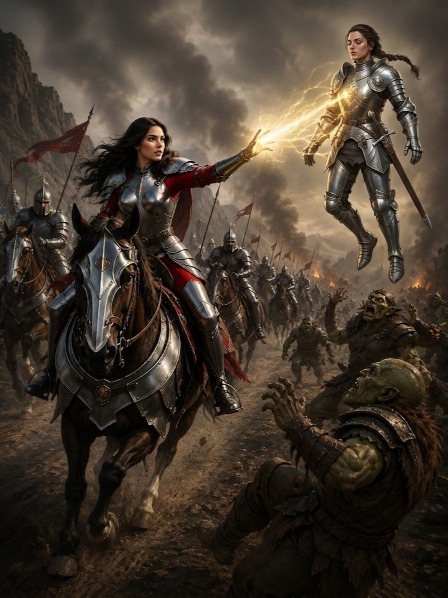
For Coralin — paladin priestess, knight, holder of two White Rose awards — this isn’t abstract doctrine. Her relationship with her god is her power source in the most literal possible sense. The state of that relationship matters. Standing isn’t a given; it’s something a cleric has to earn. It can deepen, and it can fade. It shapes what she can do in the 40-year war that began before she was born, and it shapes who she is throughout the story.
It also creates a kind of dramatic tension that I’m not sure can be generated with any other approach to fictional theology. When faith is background scenery, a character’s integrity, religious doubt, or devotion is primarily a character note — it tells you something about them, but it doesn’t change what they’re capable of doing in the next scene. When faith is mechanically real the way it is on Menelon, a cleric’s spiritual state has plot consequences. It’s not just thematic weight. It has weight in the story.
The title What God Has Ordained is meant to hold that double meaning. There is something the God of Paladins has ordained — a plan in motion, a prophecy neither of its subjects knows they’re living inside. And the entire story is the god’s will working itself out through two people who still have to make their own choices about how god’s work gets done.
That’s not a metaphor for providence. That is providence, rendered as plot.
Why Faith-Forward Romantasy Is Rarer Than It Should Be
It’s possible that the reasons why so many fantasy authors default to background religion boils down to just one: risk management. Readers come to fantasy with wildly different relationships to faith in their own lives — some looking for it, some having been hurt by it, some indifferent. Writing a god who acts in a fantasy religion creates exposure. It invites comparison to real theology in ways that absent or ambiguous gods don’t.

I made peace with that risk because for What God Has Ordained it was the right one to take. Readers who’ve loved books like Paladin’s Grace or Daughter of the Moon Goddess already know what it feels like to be inside a story where the divine is genuinely present — where the question isn’t whether the gods exist but what they want and what that costs the people caught up in their designs. That readership exists and is hungry for it. They’re just harder to find on the shelf because faith-forward romantasy tends to be under-publicized compared to the darker, gods-as-antagonist stories.
There’s a name for the wider hunger this sits inside, too. A growing number of readers are tired of “grimdark” — the assumption that cynicism is depth and cruelty is realism — and they’ve started calling what they want instead hopepunk or noblebright:
- Stakes without nihilism.
- Heroes who win by refusing to become the thing they’re fighting.
- Virtue that actually gets rewarded instead of played for a punchline.
Faith-forward romantasy isn’t identical to either term, but it’s answering the same hunger, just from a different angle. A god who acts because doing right still matters — not despite it.
Michael and I wrote What God Has Ordained for them — and for us.
A Word on What It Isn’t
Let me make it clear that this faith-forward romantasy is not a religious novel in the sense of being a moral instruction manual or a spiritual allegory with a message to extract. I’m nobody’s guru. My spiritual journey is as unique as anyone else’s and is solely my own. The theology of Menelon isn’t a stand-in for any real-world faith tradition. The gods of this world are specific to it — alien in some ways, surprising in others, but definitely not a thinly-veiled version of anything you’ve encountered before.
It is a story that takes the premise “the divine has will, and that will acts in the world through its human followers.” It takes this idea seriously enough to follow it through to its consequences — narratively, emotionally — for the people in the middle of it who have no idea about the shape of what they’re inside.
Which is, when you think about it, an exact mirror of our own, very human condition.
What God Has Ordained — Book One of The Legacy of Chandar is coming — and if ‘clean romantasy’ is what you’re after, this is it. Want to know when it launches? The Menelon Gazette has your back!
We use AI as a tool in our creative process — for research, drafting, editing, and keyword optimization. All content contains our human creative output and reflects our own creative vision, voices, and over-riding editorial judgment.
The Menelon Gazette
If you are interested in more content like this (plus freebies, access to premium content etc.) subscribe to our newsletter for more from the world of Menelon and its creators!