



Disclaimer: I am not a psychiatrist nor licensed therapist. I’m not an expert in the field of mental health. The stories and advice in this article come from the personal experiences of a writer who has survived both writer’s block and depression.
I’ve just cycled up through another depressive bout, so the topic in the title has been on my mind. This last round practically silenced me for days. No new words for the second book, or for commenting on forum posts, or for reaching out to readers and other authors. This time, I knew it wasn’t just writer’s block. It had all the earmarks of depression disguising itself as writer’s block.
I think every article I’ve ever read on writer’s block recommends the same three things: Take a walk. Try freewriting. Just sit down and write badly on purpose. And for certain kinds of blocks — the fear-based kind, the perfectionist kind, the too-many-tabs-open kind — that advice can actually work.
After living through the last couple of weeks and trying those things, I can promise you: This isn’t that kind of post.
You see, sometimes the problem isn’t that you can’t find the right words. It’s that the well of words itself has dried up, and no amount of tricks or techniques are going to fill it. If you’ve ever sat down to write and found nothing inside you— not resistance, not fear, just a deep, black, empty hole, as still as the grave — then I hope you can hear this, and that you’ll pause for a breath or two to let it sink in: That’s not writer’s block.
That’s depression, wearing writer’s block like a costume.
The Two Lies Depression Tells You
As I said above, I know that wretched hole personally. When I’m in it, two thoughts show up like clockwork, dressed up as reasonable creative assessments.
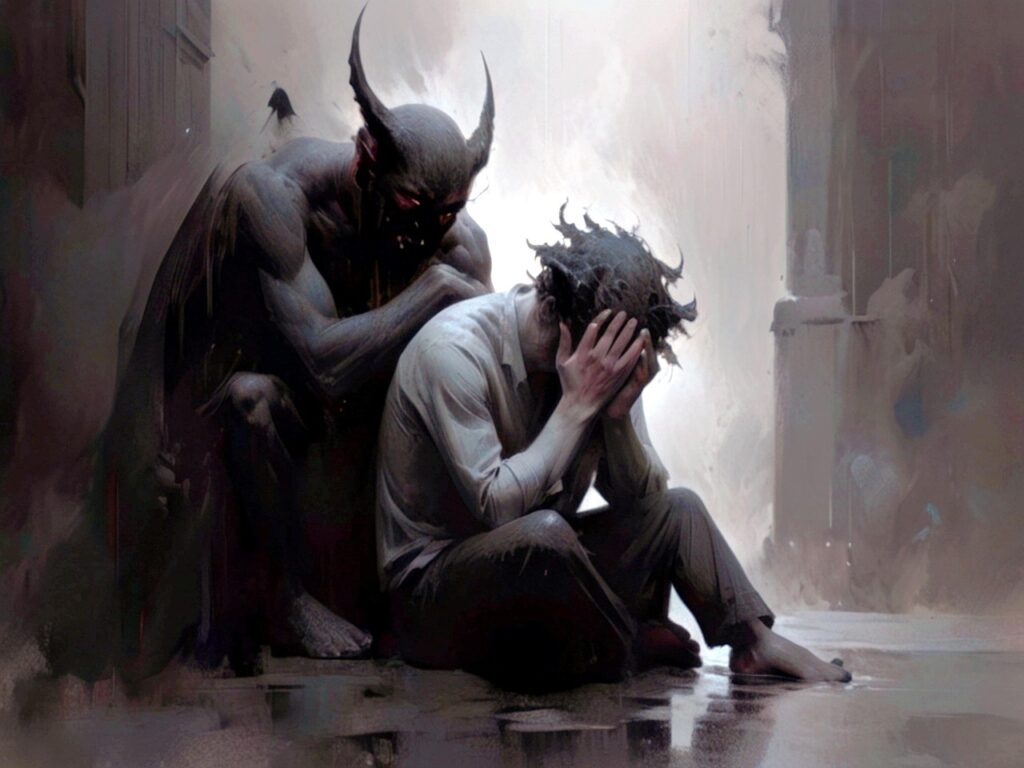
I don’t have anything to say.
I don’t have anything to say that anyone would care about.
They seem like writer’s block, don’t they. They even feel like writer’s block, in a way. A well-meaning friend will hear you say it, and suggest a prompt, a change of scenery,or a new notebook. But these two thoughts aren’t sourced in artistic or creative sources. They’re sourced in depression. It’s lying, and it’s lying to you very convincingly.
In my experience, real writer’s block, the fixable kind, says I don’t know how to say this yet. It’s a technical problem. It has texture. I can usually feel the shape of the thing I’m trying to write even when I can’t get it onto the screen.
Depression’s version doesn’t have a shape. There’s no inner wall to push against. In fact, it feels like there is nothing in there at all — no story, no idea, no light, no joy, and definitely no reason anyone would want to hear from me even if I found one. That absence is the tell. Writer’s block is frustrating, but this is something else. This is, I believe, grief for a self that has temporarily gone missing.
Why This Distinction Actually Matters
If you mistake depression for writer’s block, you’ll try to write your way out of it — and when that doesn’t work, the failure gets added to the pile of evidence that depression is already building against you. Ugh, what a pile of crap. I really don’t have anything to say, and no one wants to read it anyway. Why do I even bother? That’s the kind of lie that is dangerous. It compounds itself without any assistance.

Spotting this difference doesn’t fix the depression, but it can change how you deal with it. You’ll know better than to try to outline your way out of what may be a mood disorder. And you can stop shaming yourself for failing at a technique that was never going to work on this particular problem. Seeing depression for what it is can help you give yourself permission to address it as depression — which sometimes means rest, or professional support. And it almost always means simply waiting it out with as much grace for yourself as you can find.
Whatever else you do, remember that the well isn’t broken, it’s just empty for now. Remind yourself — daily, or sometimes even hourly — that it is the nature of a well to refill.
Writer’s Block Rehab: What Helped Me Come Back
Formulas are useless here, because the part of me that gets depressed can think its way around a formula in almost no time. But, there are a few things that have helped me find my way back to the page. Eventually, one of them pokes a hole through the black shroud to let a little light in.
- Naming it correctly. The moment I can say “this is depression, not writer’s block,” some of its power over me weakens. Depression slithers off when you shine a light on it. Lies lose power when you name them out loud.
- Lowering the bar — right down to the floor. This bar is not “write a chapter,” nor even “write a paragraph.” Sometimes it’s as simple as “open the file.” That’s the whole goal. Some days that’s all there is, and if I manage it, that’s allowed to be enough.
- Listening to music that heals my soul. I queue up a carefully curated, “never-fail” playlist with tracks that remind me of the truths I know: That I was born to be a writer, and eventually I let myself remember this truth, too: My words are too powerful to submit to the lies depression tells.
- Trusting the pattern, even when I can’t feel it. Remember, the well always refills. It has before, every time, and it will this time, too. One trick I use is write it down on post-it notes and paste them all over the place as visual reminders (these also serve as visual clues for my partner that I’m struggling with something). I recite it like a mantra, and as a defense against the poisonous lies. Depressive Me doesn’t always believe that the words will come back while I’m in the darkness, but I still remind myself often, on behalf of the version of me who does.
If You’re in the Darkness Right Now
If this is landing a little too close to home, please let me say something directly to you: You are not lazy, you are not worthless, you are not out of ideas, and you are not used up. You are a creator whose depression is currently very good at impersonating your creativity. It is a real and difficult thing to live through, and it is not evidence of anything true about your talent.
It does not mean that you are useless, or that your writing has no purpose.
Remember, and believe: The words will come back. If it helps you to know it, mine always have.
If you’re navigating depression yourself, please know that reaching out to a mental health professional or trusted support line is always a good next step — you deserve real support, not just a blog post from a fellow writer who’s been there.
We use AI as a tool in our creative process — for research, drafting, editing, and keyword optimization. All content contains our human creative output and reflects our own creative vision, voices, and over-riding editorial judgment.
The Menelon Gazette
Enjoyed this? There's more where that came from — free reads, lore, and stories from behind the page, delivered straight to your inbox. No spam, unsubscribe at any time.