
Featured image by RoySnyder from Pixabay
We get a lot of praise for how we made the fantasy world of Menelon feel “real” and “lived in.” Michael and I have often been asked how other authors can do the same with their worlds.
To answer that, I have to start by admitting that we’ve been building out Menelon as a fantasy world since 1994. When we started, we had a port city named Fernwall. It had a Clocktower and four districts where people lived: Angels, Merchants, Docktown, and South End. However improbably, there would be an elven wood in the center of the city. Most of the world was fighting a war against alien/dark-elven invaders. And that was almost all we knew.
It wasn’t much, but it was a beginning. By the time we started the first draft of Raven’s Tears we had much more than that. The process was a labor of love that took years of research. Then we spent more hours talking things out and “play-testing” with fleshed-out characters that followed RPG rules (FATE core, in our case). Each decision we made led to more questions, which lead to more research, and more debate, until we got to something that felt right.
How to Make a Fantasy World Feel Real
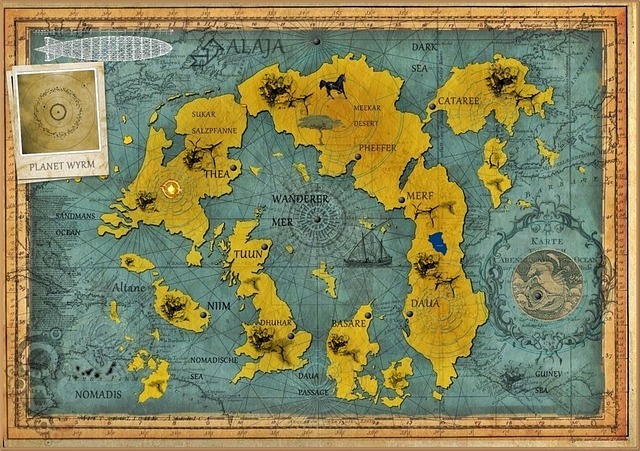
As I intimated above, deep fantasy worldbuilding isn’t easy, and it isn’t achieved quickly. But our experiences taught us that there are some things anyone can do to get a fantasy setting, if not the world, onto a map relatively quickly. My general advice is to start small and build out from there, because it worked for us.
Then start asking, and answering, questions in these three primary areas:
- Geography/Environment — What are the physical features of your setting? Are there mountains nearby? Rivers? Forests? Mud flats? Or sand dunes? Is it a coastal town? How big is that ocean? What is the climate like? Are there seasons in a year? How many, and what do they feel like? What climate catastrophes occur, and how often? Have any of them changed the landscapes? Are the inhabitants tied to the seasons? What resources does this environment produce? What is the economy based on? How do they trade?
- Races/Culture/Traditions — What unique cultural practices, festivals, and rituals do the peoples in this place observe? Are there civic festivals? Religious rites? And what do they revere or even worship? Are they humans? What languages are spoken? What dialects? Are there other species/races living nearby? What are the relationships between them like? Historically, have they been good neighbors, or is there bad blood between them?
- History/Politics — Take the time to think up and outline significant events that have shaped the setting’s current state. Was there war? Invasions? Famines? What about devastating plagues? Is there a government? How is it structured? Who is in charge when the first scene begins? How are laws made? Who makes them? Who enforces them? Has rebellion or revolution ever played a part in the setting’s history? Or in its present? Are there other inter-state or international conflicts that are shaping the story?
I had to make myself stop there, but I’m sure you get the idea. Once you start this, the questions start asking themselves!
The Goal: A Detailed, Lived-in Fantasy World
There is more that goes into how to make a fantasy world feel real, of course. So, consider what I’ve given you here as a jumping-off point—and make sure you have working wings or a trusty jet pack before you get started. *ahem* Metaphorically speaking, of course. The point is that the exploration is likely to make you think in ways you’ve never had to before. It will take you to places, in thought at least, that you’ve never been, before. I find that exciting, and I hope you do, too.
Eventually, you will reach a point in this where you feel you’ve got enough to begin writing or gaming in this new setting you’ve created. In fact, you have probably already been telling yourself stories about some of those answers as you came up with them. Write them down! It’s probable that at some point the details in them will become the history and/or the lore of your brand new world, just as it did for us when we built out the World of Menelon for What God Has Ordained.
In the next installment, I’ll be talking about using sensory awareness—and words—in your storytelling to make that new world of yours come alive. See you then!
We use AI as a tool in our creative process — for research, drafting, editing, and keyword optimization. All content contains our human creative output and reflects our own creative vision, voices, and over-riding editorial judgment.
The Menelon Gazette
Enjoyed this? There's more where that came from — free reads, lore, and stories from behind the page, delivered straight to your inbox. No spam, unsubscribe at any time.