

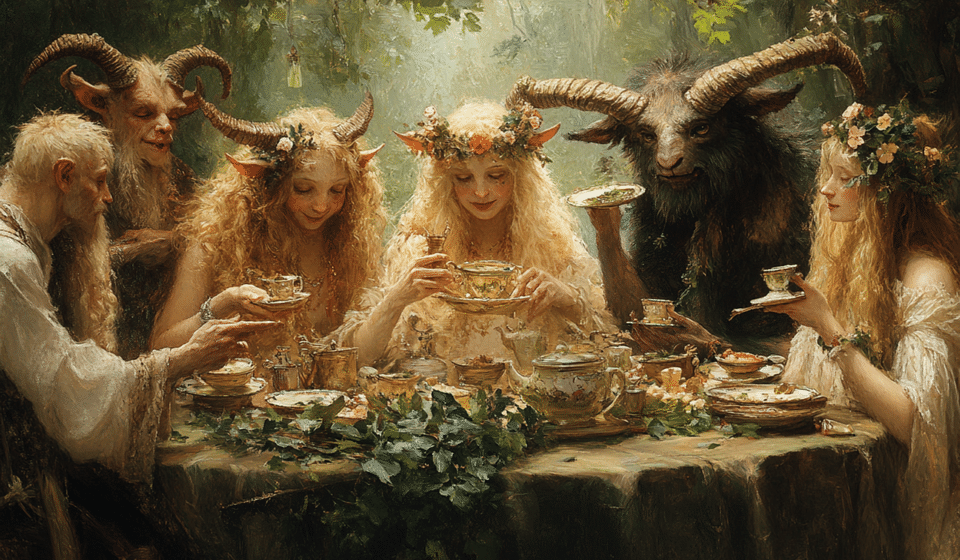

Featured image by Lisa Yount from Pixabay
Pan’s Labyrinth is coming back to theaters on October 9th, restored in 4K and available in 3D — and I can hardly wait.
But, while were all waiting, here’s a little trivia to start a good discussion at the snack counter: in Spanish, the film is El laberinto del fauno, “The Labyrinth of the Faun.” The English-language title swapped in a god from Greek mythology, Pan.
But why? Hold that thought. That swap is a perfect example of why conversations about “faun vs satyr” (and “Pan vs faun,” and “Pan vs satyr”) trip up nearly everyone. Fantasy has been mixing these creatures up for a couple of thousand years.
So which is which?
Meet the Satyr: Greece’s Rowdiest Party Guest
Satyrs came down to us through history courtesy of the Greeks, and they belonged to Dionysus, god of wine and revelry — which tells you most of what you need to know about their manners. They drank. They danced. They played pipes. They chased nymphs (albeit usually without success). You can sum them up as, “Fun at a party, but a handful at a dinner table.”
Early Greek artists didn’t give satyrs goat legs at all. A classical satyr walked on human legs, with the ears and tail of a horse, a snub nose, and a shaggy mane — comically ugly, as the vase painters tell it. And he wasn’t always a fool. Silenus, eldest of the satyrs, tutored the young Dionysus himself, and the Greeks believed a satyr could share genuinely useful wisdom — if you could coax it out of him before the wine ran out.
Meet the Faun: Rome’s Gentler Woodland Spirit
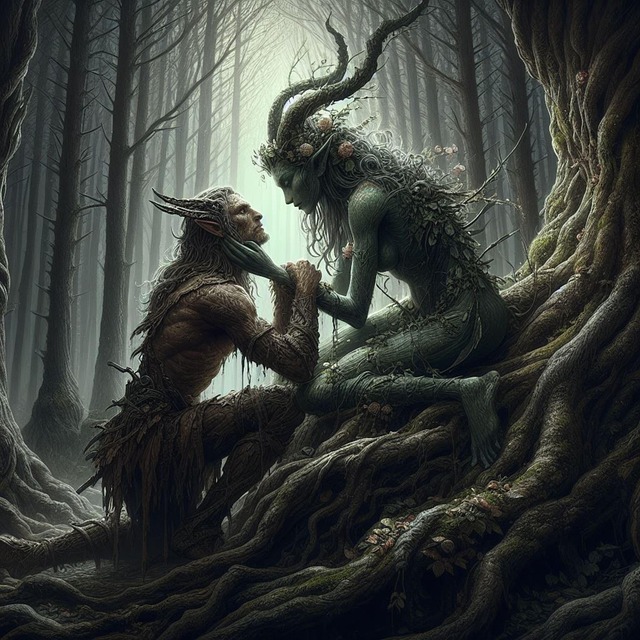
Fauns come from the Roman mythos: Spirits of untamed woodland, kin to Faunus, one of Rome’s oldest nature gods. Educated Romans, steeped in Greek myth, eventually decided their fauns and the Greek satyrs were more or less the same thing. But the temperaments never quite matched. A faun was usually imagined as a shy woodland creature rather than a boisterous drunk, and fauns lacked the satyr’s reputation for secret wisdom. Roman-era fauns were also unmistakably goat-legged: a man from the waist up, with the legs, hooves, tail, and horns of a goat.
To sum up, a satyr is Greek and a faun is Roman, and over the centuries the two melted into the half-human, half-goat woodland figure we all picture today. By the Renaissance, artists had stopped bothering to tell them apart. Modern fantasy hasn’t done much better — C. S. Lewis’s Mr. Tumnus, umbrella and all, is a faun, while Rick Riordan’s Grover Underwood is a satyr, and both have goat legs, horns, and far better manners than the originals.
So where did all those goat legs come from? Pan, of course!
Where Pan Fits In (Pan vs Satyr, Pan vs Faun)
Pan is a Greek god of shepherds, flocks, wild places, and rustic music, with the legs, hindquarters, and horns of a goat. He could also be multiplied into a whole crowd of little Pans, the Paniskoi, who turned up in Dionysus’s retinue and played the same part the satyrs did. The two crowds blurred together, and by the Hellenistic period satyrs were being shown with goat features of their own.

That settles Pan vs satyr: Pan is the god, and satyrs are the rowdy spirits who borrowed his legs.
Pan vs faun is the same story across a border. The Romans folded Pan into their own Faunus — and the original Faunus wasn’t horned until they had. Plenty of Romans kept the two separate (Virgil mentions both in the Aeneid), but the mix-up had already stuck. (And yes, Pan is where we get the word panic. Wake him from his afternoon nap and you’ll understand.)
Which brings us back to that English movie title. Guillermo del Toro has said the faun in his film isn’t Pan, and in a BFI interview he indicated the English title simply sounded better than The Faun’s Labyrinth. I still think the Spanish title is the more intriguing one.
Faun vs Satyr in D&D and Other Games
Role-playing games inherited the muddle, and left it to gamers to sort out. The satyr has been in Dungeons & Dragons since 1976, and the original Monster Manual pictured it as a woodland frolicker with a weakness for piping and wood nymphs. Whether your game gives you one creature or two is up to the rulebook, so check the stat block (and your Game Guide/Storyteller) for the version your table uses, then decide whether you want the gentle guide or the party animal.
On Menelon, a Faun Is Just a Faeling Having a Good Day
Menelon has no race of fauns. No race of satyrs, either — or dryads, or nymphs, or sylphs, or any other faerie out of Earth’s myths. And yet they turn up on Menelon in exactly those forms and an infinitude of others. Here’s why.
The faelings are creatures of chaos, with no true form and no memory of their own. When a faeling comes to Menelon, its shape is acquired at random, and so are the “memories” it borrows to get through the visit. For a while it lives and experiences time much as humans do. Then it returns to its realm and dissolves back into the primordial chaos it came from. The next time it visits, it won’t look the way it did before, and it won’t remember what it knew.
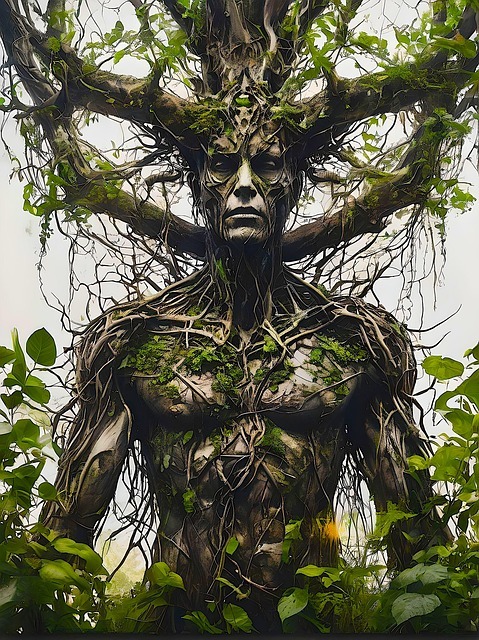
So, the faeling who amused itself with you as a pixie may someday turn up as a satyr with a wineskin, and neither of you will know the other — before either of you starts drinking whatever is in that wineskin. It might remember you. It might not. You certainly won’t recognize it, and after drinking faeling wine you may not even recognize yourself the next day.
You can think of the fauns and satyrs who show up on Menelon as the party fae. (Yes, really.)
Faelings seem to love two places above all: faerie circles and dragon lairs. No one knows why. They can slip in and out of Menelon wherever they please, so it isn’t as if they need the circles — they simply gather there in large numbers. Faerie circles are portals between dimensions, and the elves are the ones who live with them, study them, and work with them. A wood only earns the name “elven wood” if it holds an active, working circle.
Here’s the twist. Technically, the elves and the dragons count as fae, too, since they’re creatures of the god Eldar. But they don’t come and go from the chaos realm. They keep one consistent existence for the whole of their lives, which is exactly what a faeling can’t do.
So what’s the real difference between a faun and a satyr on Menelon? Whatever vibe the chaos happened to pick that morning!
If Menelon has caught your imagination, we’d love for you to visit it in What God Has Ordained, Book One of our epic romantasy series, The Legacy of Chandar — available now!
What do YOU think? If you wandered into a dark wood tonight, would you rather meet a gentle faun or a rowdy satyr? Tell us in the Comments below — I would purely love to hear which one you’d choose! (On Menelon, you might meet both. Same faeling, different day.)
We use AI as a tool in our creative process — for research, drafting, editing, and keyword optimization. All content contains our human creative output and reflects our own creative vision, voices, and over-riding editorial judgment.
The Menelon Gazette
Enjoyed this? There's more where that came from — free reads, lore, and stories from behind the page, delivered straight to your inbox. No spam, unsubscribe at any time.