

Par-Isen: The Sacred Geography of the Paladins’ Holy Land

Featured image by TheDigitalArtist from Pixabay
Exploring a fantasy world is one of the best ways to see what a people truly value — their rituals, where their faith comes from, how they gather to celebrate and to mourn. In the fantasy world of Menelon, there is one place revered by the Medini people beyond all others.
It was their birthplace, the cradle of their now rich and varied cultures. More than just a location pin on the map, Par-Isen is their holy land, and it has shaped the entire plot of What God Has Ordained before the story even begins. It’s where Coralin spent fifteen years becoming the woman Athos meets again, and knowing more about the place helps explain why that reunion carries the weight it does.
Here’s a reader’s guide to it — no spoilers past what’s already in the book’s own description.
Par-Isen’s Place in Menelon
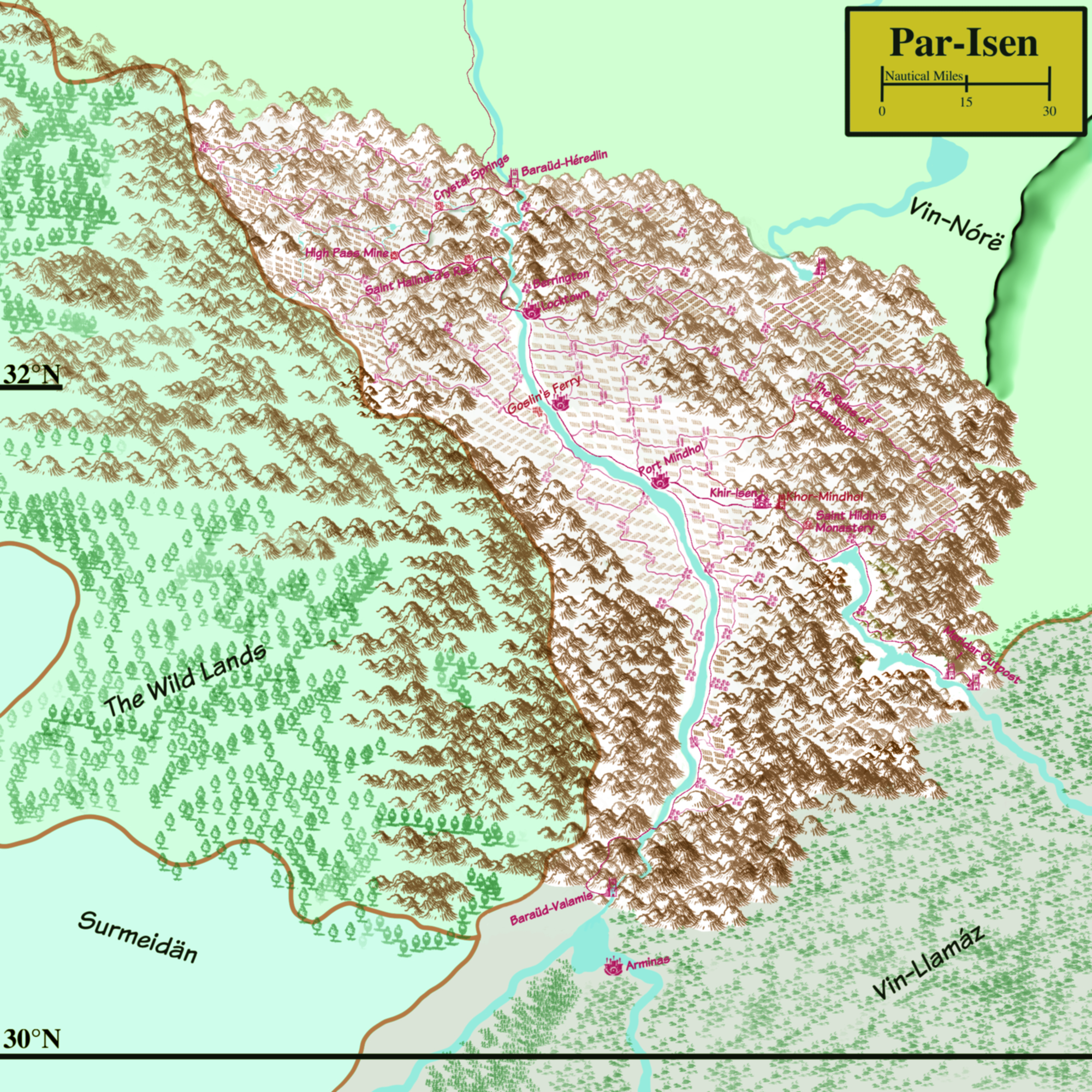
Par-Isen is on the continent of Sylantia. It is also called “the Holy Land,” and is the place where the Medini people originated. It is the ancestral homeland that gave birth to modern nations like Vin-Nórë to the north, and Vin-Llammáz to the south. A high valley ringed by mountains, it is rich in minerals and blessed with abundant water sources in the Héredlin and Meridar Rivers. By Coralin’s time, most of the floor of the Vale of Isen had been converted to rich agricultural land and was well-settled by the human populace.
Khir-Isen is the largest city, and Par-Isen’s capital. Other cities or large towns are Meridar, Locktown, and Valamís, which in Coralin’s time houses the government of Vin-Llammáz in exile. Smaller towns, villages, and hamlets freckle the valley floor, and it is never more than half a day’s travel on foot from one to the next.
Par-Isen as a nation-state is not ruled by a king or queen. It answers to the head of the Guardian Paladin Church instead, which makes it something rarer in fantasy worldbuilding than another kingdom: a theocracy that multiple secular nations still trust enough to keep consulates there. That detail matters more than it sounds like it should. A holy land that other governments are willing to maintain diplomatic offices inside isn’t just sacred ground — it’s neutral ground, (mostly) respected by powers that don’t otherwise agree on much.
The Places Every Reader Should Know
Certain places in Par-Isen are known throughout Medini culture, and beyond it. Before the war, the holy land was a place of pilgrimage. Forty-plus years later, it’s become a refuge for those whom war has displaced from their homes.
The Great Gate of Baraüd-Héredlin
Carved from canyon rock and spanning the Héredlin River, Baraüd-Héredlin is the fortress gate that marks Par-Isen’s northern entrance. It’s less a wall than a statement: whatever’s coming through has already been seen, assessed, and allowed. It’s also where Athos and Coralin’s reunion takes place — in front of a full battalion, which tells you something about how public a life inside the Guardian Paladin Church actually can be.
Khir-Isen, the Holy City

Deeper inside Par-Isen sits Khir-Isen, the Holy City, originally built atop Mount Isen and clearly visible from the valley floor. It is the seat of the church’s authority and home to the Grand Cathedral of Paladins, the sacred ground for the Medini religion as well as for the worshippers of Valïa. Next to it is the enormous fortification of Khor-Mindhol, home to the mighty khúrin-chavalleren, the holy knights sworn to defend the church and the Medini against all enemies commanded by the High Lord Marshal. If Baraüd-Héredlin is the threshold, Khir-Isen is the destination everyone in this story is either traveling toward or serving from.
Saint Hilden’s Monastery
Saint Hilden’s Monastery matters because it’s where Coralin trained to control her mystical gifts. The Valïans maintain the cloister, the chapel, and the grounds, guided and assisted by the Paladin clergy. Seated high in the mountains, it is a place of retreat, especially for those who are mystics, and it holds the largest library of mystics’ works in the holy land. Saint Hil’s, as it’s affectionately known, is a quieter corner of Par-Isen, and a reminder that every Paladin’s life has room for stillness and contemplation between duties.
Crystal Springs, High Pass Mine, and Saint Halinard’s Rest

These three settlements string out along the marching road (formerly called the “Pilgrims’ Way”) between Khir-Isen and Baraüd-Héredlin, each one a waystation for knights and retainers traveling between the holy city and the Great Gate. Crystal Springs, the northernmost, is built to outfit the khúrin-chavalleren passing through — its own chapel and small monastic complex sit beside the usual camp trades. A day’s travel south, High Pass Mine sits where three valleys meet, hauling foodstuffs and ore down to the valley floor; the mix of miners and soldiers passing through has earned it a reputation as the “party stop” of the journey. Saint Halinard’s Rest, at the top of the long climb from the valley floor, keeps a veterinary clinic busy with exhausted draft animals — its namesake monastery is now a reverently maintained ruin, though the chapel still stands and still serves as a place of worship for locals and knights alike.
Who Rules?
Throughout most of its existence, the rulership of Par-Isen has been the duty of its Yl-Sarjaan, roughly equivalent to an archbishop in our world’s Anglican tradition. But when an Imprimæ arises from within the church’s clergy, Vey (they) take on the rulership and well-being of all Medini, not just those within Par-Isen’s borders. An imprimæ — one consciousness in two bodies — begins as a married male and female priest first recognized as strong, or “loud,” echoes of the Lord and Lady of Paladins. Becoming one is a decades-long mystical journey, and an exceedingly rare achievement.

Who Keeps the Peace: The Khúrin-Chavalleren
The knight-paladins of the Guardian Paladin Church are called khúrin-chavalleren, and they’re sworn to defend the faithful. The training of a khúr-chaval is arduous, consisting not only of martial training with sword, shield, horse, and armor, but also much religious and spiritual training. The former keeps them grounded in their faith, and the latter allows them to channel the power of the God of Paladins — to heal after battle, to detect evil, lies, and treachery, and to protect the innocent wherever they may be from the walking dead and other intrinsically malevolent threats. They are the most-feared fighting force on the face of Menelon, and with reason.
A Sanctuary — But Not Always a Safe One
Par-Isen is more than just scenery: for all of Coralin’s fifteen years there, the Holy Land stayed out of the war with the Confederation entirely. No pitched battles, no border incursions. It is kept safe by the knights-paladin who guard its borders. It is safe — right up until it isn’t. And even then, what breaches Par-Isen was not an enemy army. As the book’s own description puts it, an enemy has already marked Coralin as the easier target to kill. Enemy infiltration is a very different kind of danger than an outright invasion, and it’s the one Par-Isen actually has to face.
That’s also, in a lot of ways, the whole point of setting so much of What God Has Ordained there. Par-Isen is where Coralin took her vows as a priestess and knight. It’s where she earned her coveted White Rose awards for valor and gallantry, and where she quietly and earnestly loved someone she’d convinced herself was only ever going to be her foster-brother. The Holy Land didn’t just house her for fifteen years. It made her who she is when Athos rides through the Great Gate to find her again.
What God Has Ordained is available now. Get your copy today.
Want to meet the priestess-knight who calls Par-Isen home? Read her profile here. And if Menelon’s approach to magic and miracles caught your attention, start with our breakdown of the five classes of magic users — Par-Isen’s paladins don’t belong in any of them.
Is there a fantasy holy land from another series that’s stuck with you — one that felt like more than just a map marker? Point us to it in the comments below — you’ll be playing my song!
We use AI as a tool in our creative process — for research, drafting, editing, and keyword optimization. All content contains our human creative output and reflects our own creative vision, voices, and over-riding editorial judgment.
The Menelon Gazette
Enjoyed this? There's more where that came from — free reads, lore, and stories from behind the page, delivered straight to your inbox. No spam, unsubscribe at any time.